
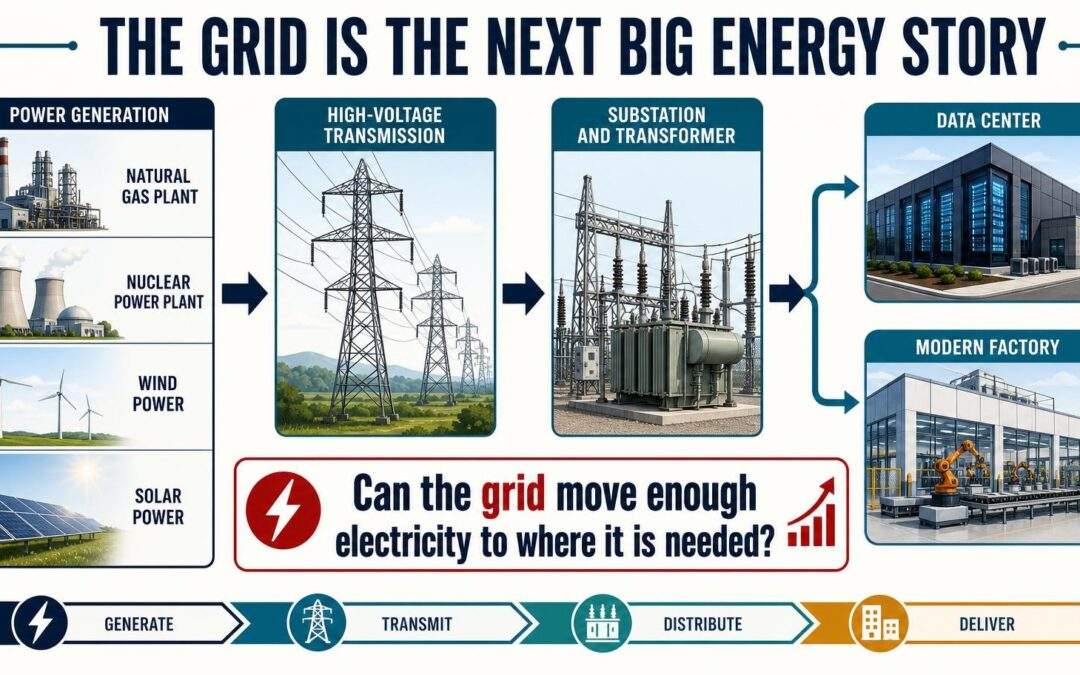
For years, most energy conversations started with one question: What will generate the electricity?
Coal, natural gas, nuclear, solar, wind, and batteries usually got the attention.
That question still matters. But another one is becoming just as important:
Can the grid actually move enough electricity to where it is needed?
The United States is entering a period of electricity growth that looks very different from the last two decades. Data centers are expanding. Manufacturers are building new facilities. More parts of the economy depend on electricity.
At the same time, power plants cannot simply plug into the grid overnight. New customers cannot always connect when they want to. Transmission lines, substations, transformers, and other equipment all have limits.
That makes the grid itself one of the most important energy stories to watch.
Electricity Demand Is Growing Again
For much of the 2000s and 2010s, U.S. electricity demand barely moved.
That period appears to be ending.
The U.S. Energy Information Administration expects electricity sales to reach about 4,135 billion kilowatt-hours in 2026, nearly 2% above 2025. EIA expects another increase in 2027, bringing sales to about 4,211 billion kilowatt-hours.
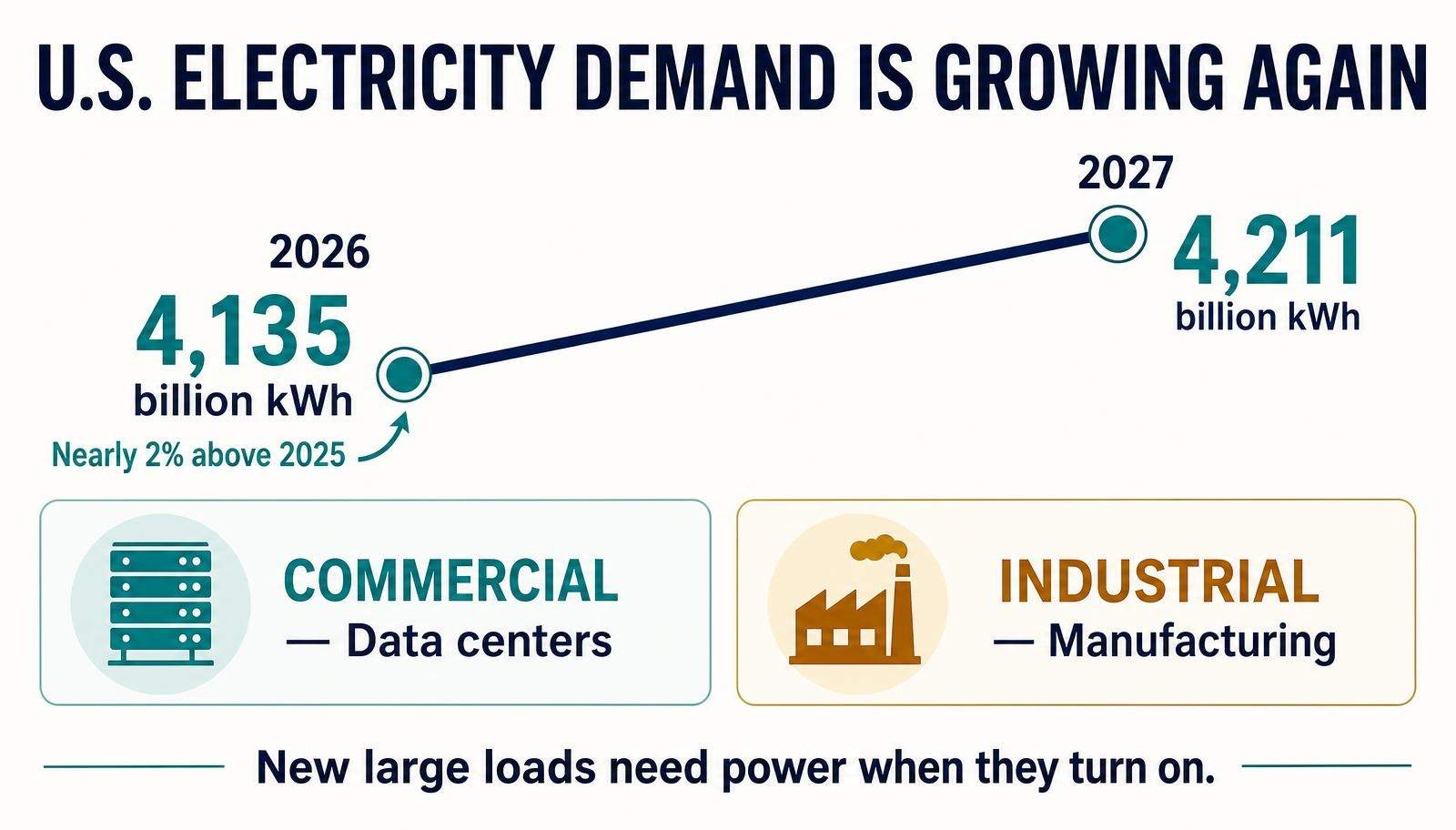
Two areas are driving much of that growth: commercial demand and industrial demand.
Data centers are an important part of the commercial side. Manufacturing is adding pressure on the industrial side.
This matters because the electric system has to respond to demand in real time.
A new factory cannot wait for electricity until the grid catches up. Neither can a large data center.
The power has to be available when those facilities turn on.
Building Power Plants Is Only Half the Job
Suppose a developer builds a new natural gas plant, solar farm, wind project, or battery facility.
That does not mean the electricity can immediately reach customers.
The project must connect to the transmission system.
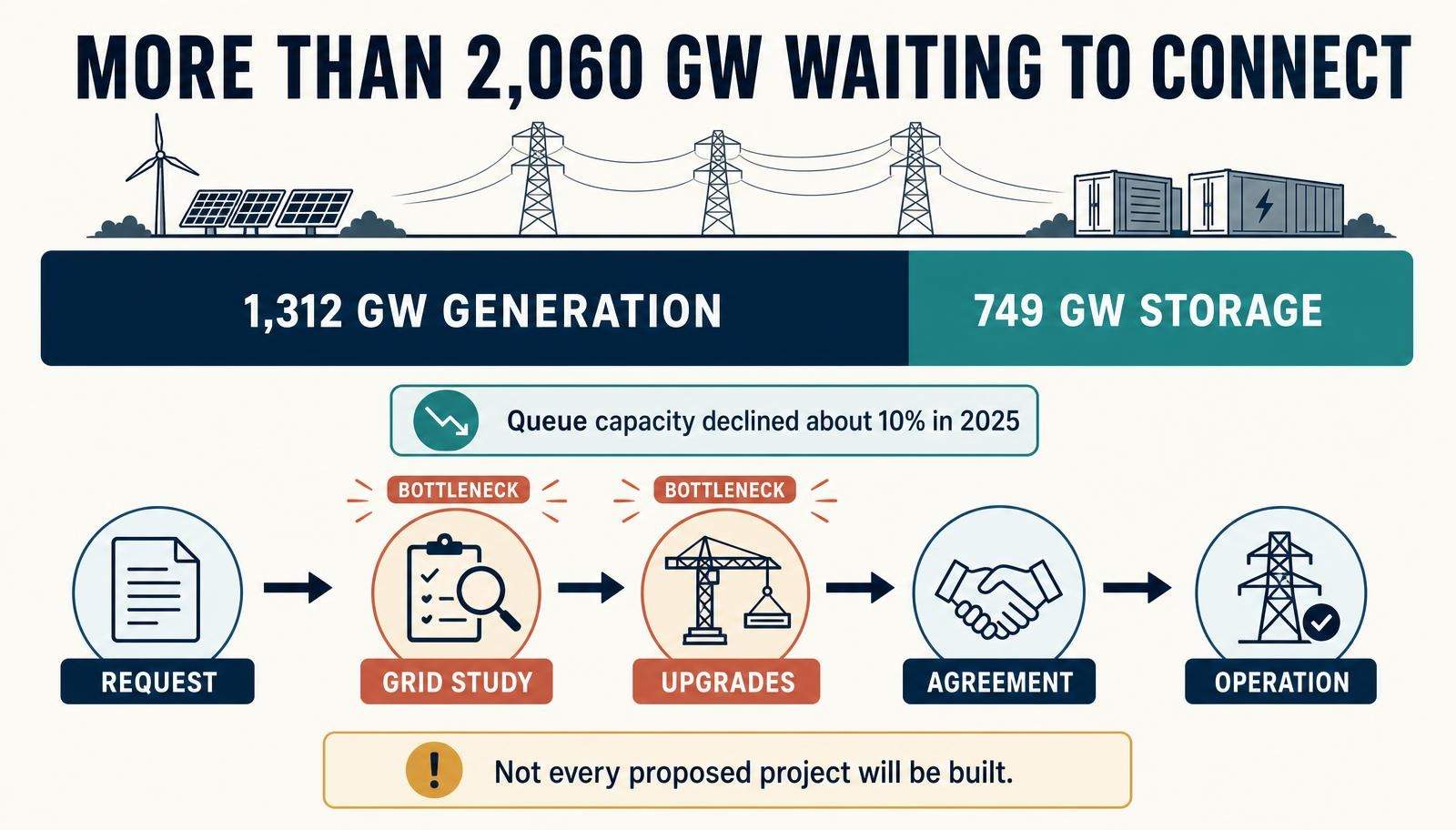
Before that happens, grid operators study whether the system can handle the added power. They may find that new lines, substations, or other upgrades are necessary.
That process has become a major bottleneck.
Berkeley Lab reported that more than 2,060 gigawatts of generation and storage capacity were actively seeking connection to the U.S. grid at the end of 2025. That included about 1,312 GW of generation and 749 GW of storage.
Put that number in perspective. There is an enormous amount of proposed energy capacity waiting somewhere in the process.
Of course, not all of those projects will get built.
That is normal.
The more important point is that connecting new electricity supply has become a process that can take years.
The Queue Is Getting Better, but It Is Still a Queue
There has been some progress.
The amount of generation and storage waiting in U.S. interconnection queues declined about 10% during 2025. Grid operators also completed more interconnection agreements in several regions.
That is encouraging.
However, the underlying problem has not disappeared.
Berkeley Lab found that projects reaching commercial operation now tend to spend much longer in the interconnection process than projects did years ago.
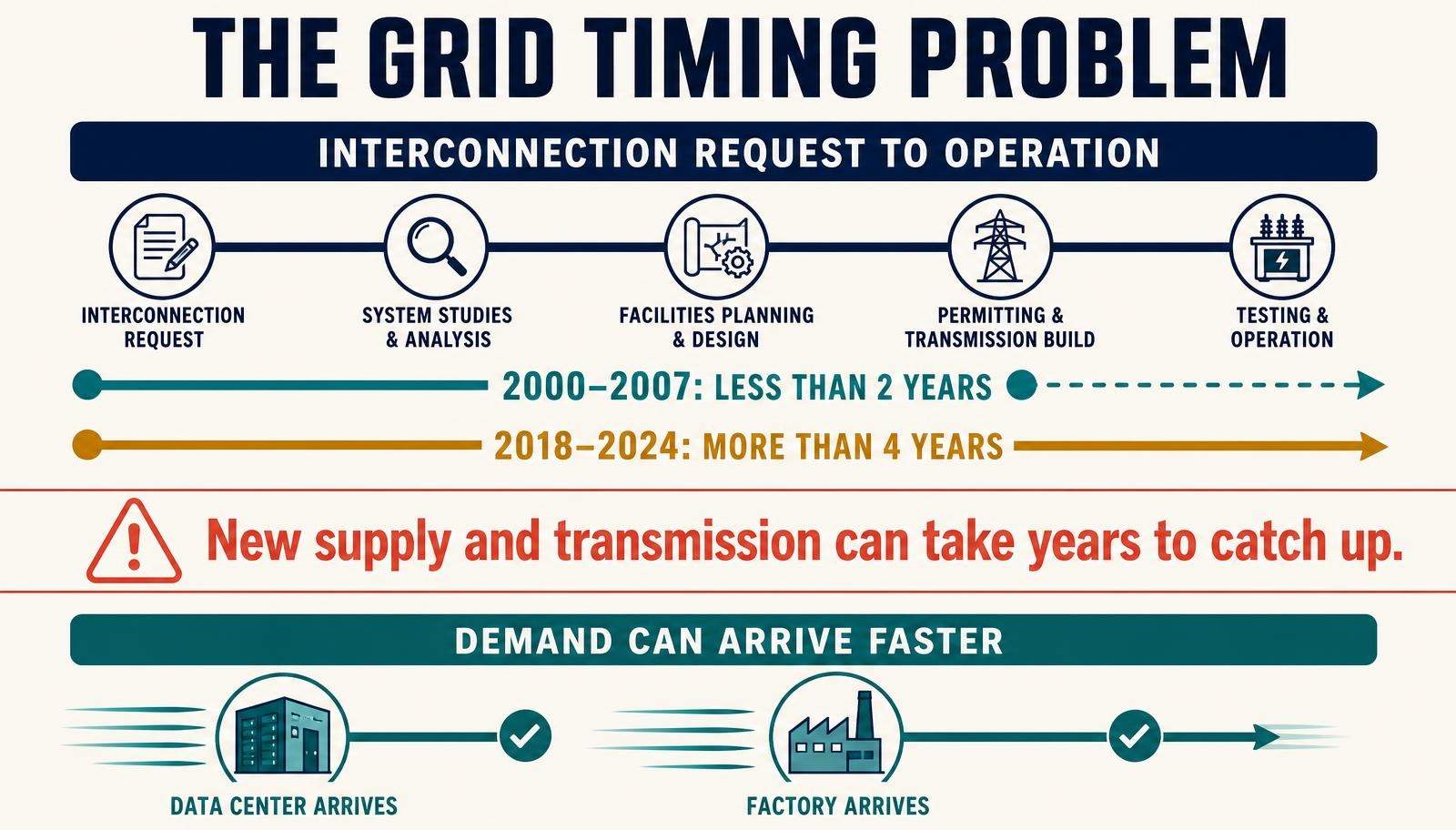
Earlier research found that the median time from an interconnection request to commercial operation had grown from less than two years for projects built from 2000 through 2007 to more than four years for projects built from 2018 through 2024.
Four years can feel like an eternity in a market where electricity demand is changing quickly.
That creates a timing problem.
Demand can arrive faster than new supply and transmission infrastructure.
The Grid Has to Catch Up With the Economy
The Department of Energy made this issue clear in its 2026 National Transmission Needs Study.
DOE said the country has a pressing need for more transmission infrastructure because of growing electricity demand from data centers, manufacturing, large industrial facilities, and broader economic growth.
That is an important shift.
For years, transmission debates often centered on how to move new renewable power from remote areas to population centers.
That challenge remains.
Now the grid also has to serve rapidly growing loads.
In other words, the question is no longer only:
How do we connect new power plants?
It is also:
How quickly can we connect the new customers that want all that power?
Berkeley Lab has identified large-load connections as an emerging bottleneck in their own right. Data centers and other large electricity users are creating new challenges for utilities, grid planners, regulators, and investors.
Data Centers Make the Timing Problem Harder
Data centers deserve attention here, but not because they are the whole story.
They are important because they can add very large electricity loads in a relatively short period of time.
That does not match well with infrastructure that may take years to plan, permit, finance, and build.
The North American Electric Reliability Corporation has said new data centers and other large commercial and industrial loads account for much of the projected rise in North American electricity demand over the coming decade.
NERC has also warned that uncertainty around new power resources creates reliability concerns in several regions.
That does not mean the country is about to run out of electricity.
It means planners have less room for delay.
A data center developer may think in terms of a few years. A major transmission project can take much longer.
That gap matters.
Sometimes the Fastest New Grid Is the Grid We Already Have
Building entirely new transmission lines will remain necessary.
However, new lines are not the only answer.
Utilities can sometimes move more power through existing corridors.
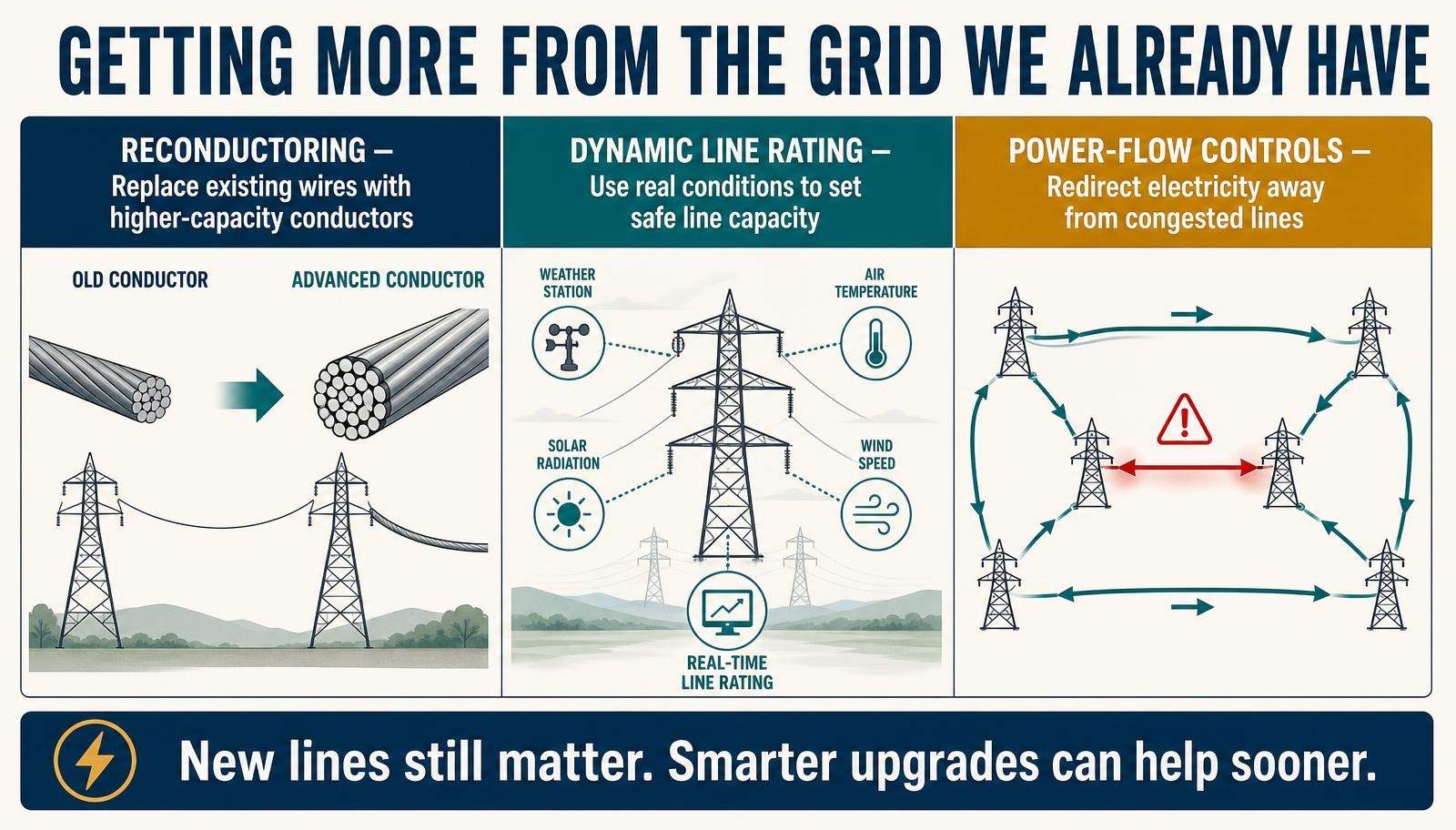
One approach is reconductoring. Instead of building a completely new transmission route, a utility replaces existing wires with conductors that can carry more electricity.
Other technologies can help operators use existing lines more efficiently.
For example, dynamic line rating uses real conditions to determine how much electricity a transmission line can safely carry. Power-flow controls can help move electricity away from congested lines and toward parts of the network with room available.
DOE has been putting more attention on these technologies. In March 2026, the department announced roughly $1.9 billion in funding aimed at grid upgrades, including advanced conductors and other transmission technologies.
This is an area I think deserves more attention.
Energy infrastructure discussions often turn into debates about which source should generate the next megawatt.
Yet there can be real value in asking how much more electricity we can move using infrastructure that already exists.
The Small Components Matter Too
The power grid is not just towers and wires.
It depends on transformers, switches, control equipment, sensors, substations, electronics, and thousands of other components.
That makes supply chains important.
DOE has been working with utilities and manufacturers on distribution transformer supply issues. One challenge is the sheer number of different transformer designs used by utilities across the country.
DOE says more than 80,000 different distribution transformer varieties exist nationwide.
Modern grids also rely heavily on power electronics.
Devices built around power semiconductors, for example, help control and convert electricity in everything from industrial equipment to renewable systems and parts of the electric grid.
These components may not attract the same attention as a nuclear plant or giant data center.
But an electricity system only works when all the pieces work together.
That is one reason I look at the grid as a system rather than a collection of power plants.
More Electricity Does Not Automatically Mean Cheaper Electricity
Rising demand can be good for utilities and power producers.
But investors should be careful with the simple idea that more electricity use automatically creates more profit.
Someone has to pay for new infrastructure.
Transmission lines cost money. Substations cost money. Generating plants cost money. Upgrading existing lines costs money.
Regulators then have to decide which costs utilities can recover and who should pay them.
Consumers care about reliability, but they also care about monthly bills.
Large power users care about getting connected, but utilities have to make sure existing customers do not carry an unfair share of the cost.
Those questions will become more important as demand grows.
FERC’s Order No. 1920 requires transmission providers to take a longer-term approach to regional transmission planning and cost allocation. The rule is designed to make the grid plan further ahead instead of responding only after a need becomes urgent.
The details may sound technical.
The financial impact is not.
What I Would Watch From Here
For investors, utilities, and anyone following the energy market, I would watch five things closely:
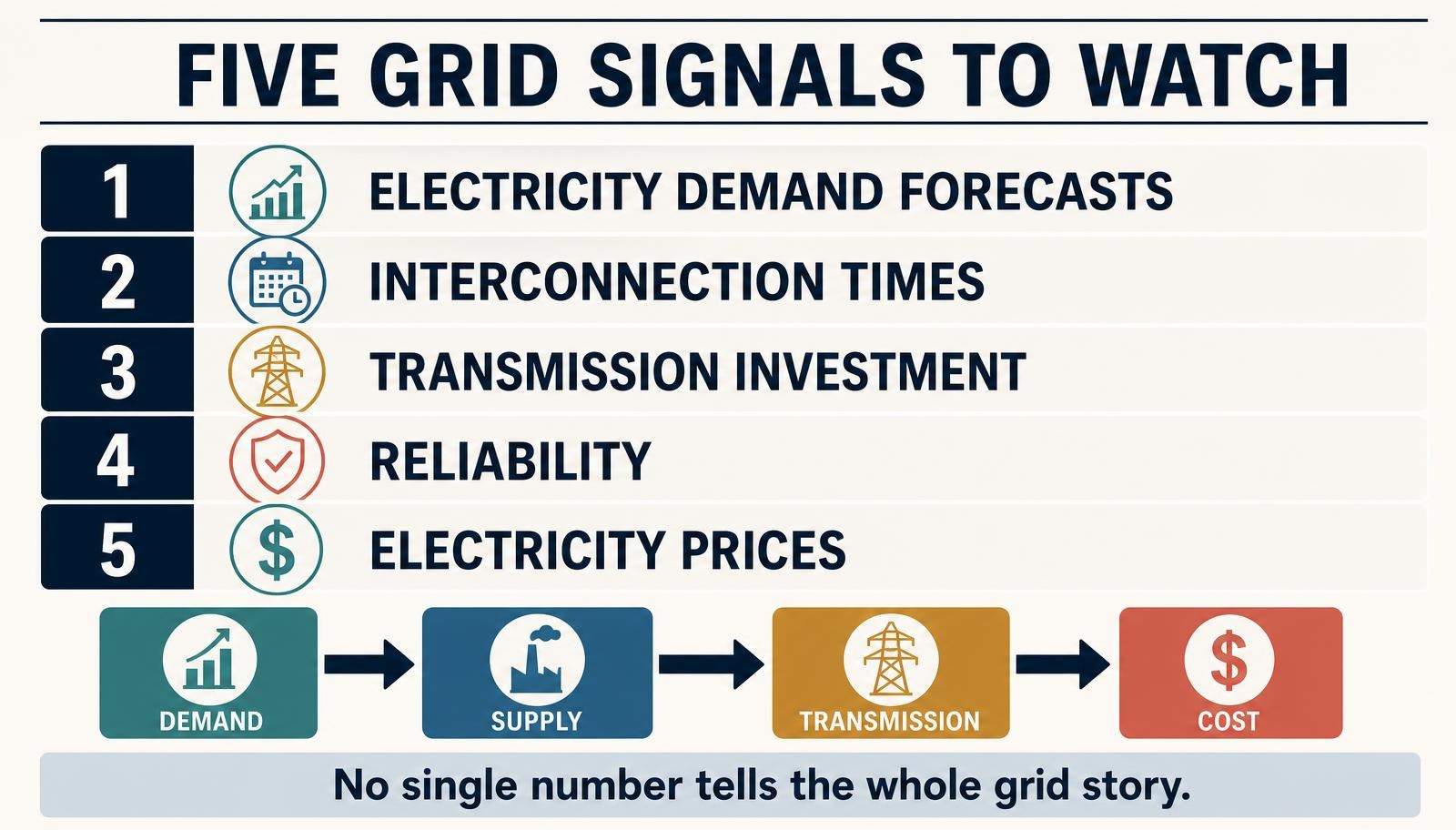
- Electricity demand forecasts. If forecasts continue rising, the pressure to add generation and grid capacity will grow.
- Interconnection times. Faster approvals could help new supply reach the market sooner.
- Transmission investment. Spending on lines, substations, conductors, and grid equipment could become a larger part of the energy investment story.
- Reliability. Regions with fast demand growth will have to show they can maintain enough dependable supply.
- Electricity prices. The cost of expanding the system eventually matters to homes and businesses.
None of these factors works alone.
A region may have strong demand but weak transmission. Another may have plenty of proposed generation but long interconnection delays. A third may have adequate capacity today but a much larger load coming in three years.
That is why I would avoid trying to reduce the grid story to one number.
The Next Energy Boom May Be an Infrastructure Boom
Energy markets have always rewarded people who look beyond the headline.
Right now, the headline is often artificial intelligence and the enormous amount of electricity that data centers could consume.
That matters.
But the deeper story is what has to happen around that demand.
Power must be generated.
It must be connected.
It must move through transmission lines.
Voltage has to be managed.
Transformers and substations have to handle the load.
The system has to remain reliable when demand peaks or equipment fails.
And someone has to pay for all of it.
The United States has no shortage of companies that want to build new generation. More than 2,000 GW of proposed generation and storage sitting in interconnection queues makes that clear.
The harder question is how quickly the rest of the electric system can grow around it.
For investors, utilities, policymakers, and customers, that may become one of the defining energy questions of the next decade.

David Rewcastle of Darien, Connecticut, is an Equity and Fixed Income Analyst with a background in Finance and Middle East Studies