
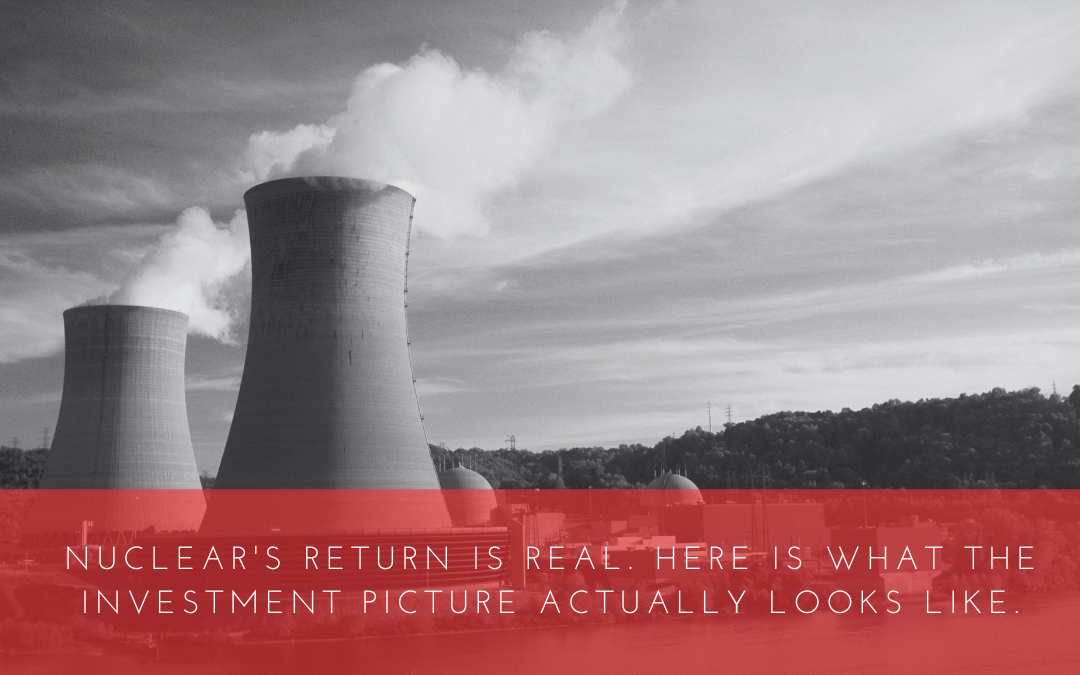
Nuclear energy was supposed to be a declining industry. High construction costs. Long timelines. Public skepticism. For most of the 2010s, that narrative held. Plants were closing faster than new ones were being approved. The economics of merchant nuclear in competitive power markets looked increasingly challenged against cheap natural gas and falling renewables costs.
That story has changed. The driver is data centers and the AI infrastructure buildout behind them. In roughly 18 months, nuclear went from a managed-decline sector to the most sought-after power source for the largest technology companies on the planet. Understanding what actually happened, and what the investment implications are, requires separating the genuine structural shift from the noise.
What Changed: The Demand Signal Is Unmistakable
The fundamental problem technology companies are solving is simple to state and difficult to address. AI workloads require power around the clock, seven days a week, at very high density. Solar and wind cannot provide that on their own. They produce power intermittently, and the battery storage required to firm that power to a baseload level at gigawatt scale does not yet exist at competitive cost. Natural gas can provide firm power, but it carries emissions implications that technology companies with public net-zero commitments are reluctant to accept.
Nuclear solves the problem directly. It runs at a capacity factor above 95 percent. It produces no direct carbon emissions during operation. And the existing fleet can deliver power without the permitting and construction risk that new capacity of any kind carries.
The deals that have followed are large enough to represent a structural shift rather than a trend. As of May 2026, every major technology hyperscaler has signed at least one nuclear power agreement, with 13 announced projects committing over 9.7 gigawatts of contracted capacity. BloombergNEF data puts total US nuclear power purchase agreements at more than 16 gigawatts by end of 2024, with the majority tied to data center demand. That is a meaningful portion of the entire US nuclear generating fleet.
- Microsoft: 20-year, 835 MW PPA for Three Mile Island Unit 1 restart (Constellation Energy) — first nuclear electrons to an AI data center expected 2027
- Amazon: $700M investment in X-energy; $20B+ Susquehanna campus development; 1.92 GW PPA with Talen Energy through 2042
- Google: 500 MW from Kairos Power SMRs, expected 2030 to 2035
- Meta: Up to 6.6 GW across multiple deals including TerraPower Natrium, Oklo Aurora, Vistra, and Constellation
- Oracle: Gigawatt-scale campus powered by three SMRs
The Existing Fleet: The Nearer-Term Investment Case
There are two distinct investment stories inside the nuclear revival. The first involves the existing fleet of operating nuclear plants, particularly those in competitive power markets that were previously at economic risk of early closure. Those assets have been fundamentally repriced.
A nuclear plant that was struggling to earn an adequate return against $30-per-megawatt-hour wholesale power prices looks very different when a technology company is willing to sign a 20-year agreement at premium rates for 100 percent of its output. The Three Mile Island restart is the clearest example. Constellation Energy signed that deal and immediately transformed a project that had been dormant since 2019 into a contracted cash flow stream valued by one of the most creditworthy counterparties in the world. The market repriced Constellation accordingly.
Investors who understand how the energy transition is reshaping existing asset values have seen this dynamic before. The key question for existing nuclear assets is not whether they can run. They can. It is whether the regulatory, contractual, and operational pieces align to capture the premium pricing that technology company demand has created. Not every plant is positioned equally. Geography relative to data center demand centers, grid interconnection access, and regulatory jurisdiction all matter.
The SMR Timeline: The Longer-Term Question
Small modular reactors represent the other half of the nuclear story. They are more flexible, require less capital per unit, and can potentially be sited closer to demand than large conventional reactors. Every major technology company has made at least one SMR bet, either through direct investment or through power purchase agreements contingent on development.
The timeline is the honest constraint. The first US SMRs serving commercial technology loads are realistically expected around 2030, and those will be pilot deployments. The bulk of SMR capacity enters service between 2031 and 2035. Investors pricing SMR development into near-term valuations are making a very long-duration bet, one subject to construction risk, permitting timelines, and first-of-a-kind technology execution risk that conventional nuclear has demonstrated repeatedly.
The technology company investments in SMR developers are better understood as option value and demand signal than as near-term supply solutions. They are important strategically. They are not going to change the power supply picture before 2030.
The Investment Risks Deserve Honest Space
Nuclear construction has a consistent record of cost overruns and timeline delays. The Vogtle Units 3 and 4 expansion in Georgia came in at more than twice the original estimated cost and years behind schedule. That project’s experience informed how market participants now evaluate SMR development timelines and cost assumptions. Skepticism about first-of-a-kind nuclear construction is well-founded by history.
The existing fleet faces a different risk profile: regulatory changes, operating cost escalation, and the possibility that power market structures evolve in ways that affect the economics of long-duration power contracts. Interest rate sensitivity also matters. Nuclear assets are capital-intensive with long-duration cash flows. Changes in discount rates move their valuations meaningfully.
The critical minerals required for nuclear fuel enrichment and reactor components add a supply chain dimension that is less visible than the headline investment story but material for long-duration capacity planning. Uranium supply is geographically concentrated, and enrichment capacity is a genuine constraint on how quickly the fleet can expand.
Where the Opportunity Sits
For equity investors, the most direct exposure to the nuclear demand story sits in the utilities and independent power producers that own and operate the existing fleet. Constellation Energy, Vistra, and Talen Energy have all been repriced to reflect the new demand environment, and the question for each is whether current valuations adequately capture the contracted cash flow upside or whether they have already priced the best-case scenario.
The uranium supply chain, including producers, enrichers, and fuel fabricators, provides exposure to the build-out of new capacity with a shorter timeline than SMR equity. Uranium demand from both the existing fleet and anticipated new builds has driven prices significantly above the levels that prevailed through most of the last decade. The supply response to those prices is still developing.
I have written about where capital is moving beyond the mega-cap technology names that have dominated market returns. Nuclear sits squarely in that conversation. It is not a simple story. But the demand signal is real, the structural shift is genuine, and for investors willing to do the work on individual asset quality, the opportunity is material.

David Rewcastle of Darien, Connecticut, is an Equity and Fixed Income Analyst with a background in Finance and Middle East Studies